
Buyer's Guide
Aerial Lifts Introduction
Aerial lifts come in several varieties, but they all share a basic purpose: lifting employees and their equipment for above-ground work. They're used in warehouses, manufacturing plants, retail stores, construction, utility work and any hard-to-reach location.
Whether you need to rent a basic lift for annual maintenance or buy a high-end boom lift for everyday use, this BuyerZone Aerial Lifts Buyer's Guide will help you make a decision by providing valuable information that includes:
- How to choose the right size aerial lift
- Differences between scissor lifts, boom lifts, and vertical personnel lifts
- What to look for in an aerial lift seller
- Which safety features are essential
- How much you can expect to pay for your lift - when renting or buying
Once you know the size and type of equipment you need, our free referral service can quickly connect you with aerial lift sellers in your area - free.
To get started, the first thing you want to do is have a complete picture of the job you have ahead. This will give you clear measurements that can help you begin selecting an aerial lift.
Aerial Lifts Purchasing Basics
When choosing an aerial lift, the most basic question you need to answer is: how high do you need it to reach? To figure this out, measure the height of the shelves you need to access, the equipment you need to service, or the location of the work you need to do, making sure to include any variations in ground level, ceiling height or doorframes.
Lift heights are measured to platform height - how high the floor of the lift platform (or bucket) extends. The working height is 6 feet above that: a lift with a platform height of 19 feet will enable you to work at heights up to 25 feet.
Next, consider lifting capacity: how much weight the lift needs to support. Also known as operating capacity, this can range from 300 to over 2,000 lbs. Many standard lifts have capacities of 500 to 700 lbs, enough for two workers and their equipment.
There is a limiting factor on height and capacity though, as lifts with greater capacities are also physically larger machines. If your lift is for indoor use, make sure it can move through any doorways or tight spaces. Even outdoor lifts have to fit through gates or on trailers at times. Remember to balance your requirements for height and capacity with the physical constraints of your workspace and the space leading into it.
Power choices
Most aerial lifts are self-propelled, using electricity, gas, diesel, or propane as a power source. Indoor lifts are almost exclusively electric. Most outdoor lifts run on gas or diesel for greater power and continuity of workflow, easily refilling or swapping tanks without having to recharge for hours. Dual fuel lifts provide more flexibility by allowing you to switch between gasoline for outdoor use and propane for indoor use.
Slab or rough terrain?
The industry divides aerial lifts into two major categories: slab and rough terrain lifts. Slab lifts are designed to be used indoors or on flat, smooth surfaces. Rough terrain lifts can work on uneven ground. The main differences are in the power systems and tires.
Slab lifts are often electric powered so they can be used indoors and have non-marking solid rubber tires. Rough terrain lifts are more commonly gas, diesel, or dual-fuel powered and usually have pneumatic tires for better stability and traction.
Types of Aerial Lifts
There are three main aerial lift designs. Choosing the right one for your job can be fairly straightforward once you understand the differences. They include:
- Boom lifts - Buckets on the end of extendable or jointed arms. If you need to reach up and over obstacles, you'll probably need a boom lift, as other types of lifts move mainly straight up and down.
- Scissor lifts - Flat platforms that travel straight up and down. Best for moving multiple people or large amounts of equipment or product to heights, offering more lift capacity and larger workspaces than bucket lifts.
- Personnel lifts - Single-user, vertical travel buckets. The most economical choice for single-user operations that only require vertical travel.
Boom lifts
Boom lifts come in two distinct varieties. Telescopic boom lifts (also called stick booms or straight booms) have long, extendable arms that can reach up to120 feet at almost any angle. They're often used in construction where their long reach provides access to upper stories. These are best when you need the highest, longest reach.
Articulating-boom lifts have arms that bend and often include four-wheel drive for added maneuverability. Sometimes called knuckle booms, they can reach over and around obstacles to position the bucket exactly where it needs to be. They're popular for utility work where power lines, trees and other obstacles make positioning tricky. They're also used in plant maintenance, allowing workers to reach over immovable fixtures and equipment.
Boom lifts offer the best combination of vertical and horizontal flexibility. Some models can even position the bucket lower than the base if needed. Typical boom lifts fall within these ranges:
- Platform heights from 20 feet to 126 feet
- Most popular height ranges from 20 feet to 50 feet
- Most common capacity is 500 lbs.
Many boom lifts can be fitted with a jib. This adds about 6 feet to the height and allows the bucket to be moved up and down (and sometimes side to side) without moving the main boom.
Another variety of boom lift is the trailer-mounted boom lift. Unable to move on their own, these battery-powered lifts are towed to work locations behind other vehicles. They can reach heights of 30 feet to 50 feet.
Scissor lifts
Unlike boom lifts, scissor lifts only travel vertically. However, they generally offer larger platforms and lifting capacities. The larger platform provides more space for material and personnel while allowing access to a larger work area without repositioning the lift.
Many scissor lifts have a platform extensionthat provides a horizontal reach of 4 feet to 6 feet from the top of the lift. Though limited compared to a boom lift, platform extensions provide an important amount of flexibility.
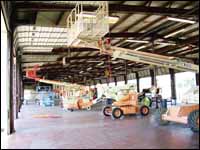
Scissor lifts most often fall into these ranges:
- Platform heights from 19 feet to 50 feet (with the low end being much more common)
- Lifting capacities from 500 to 2,500 lbs (most commonly 500 to 1,000 lbs.)
Vertical personnel lifts
As indicated by their name, vertical personnel lifts move users up and down. They're less expensive than other types of lifts and are often small enough to be moved through a standard doorway in their collapsed state.
Some specialized vertical personnel lifts can handle two workers, overlapping with low-end scissor lifts. The most common specifications for these lifts are:
- Platform heights from 12 feet to 50 feet
- Lifting capacities around 300 lbs. (usually enough for one worker and tools)
An aerial lift is more than just an unenclosed elevator – they're designed for performing big jobs at great height. Many include a number of convenient features that will enable you or your staff to work safely and efficiently.
Aerial Lift Features
After deciding on the basic type of lift you want, you should also consider the extra features that will make your work easier. Extras that can make an aerial lift more efficient include built-in carriers for tools, fluorescent bulbs, or welding equipment.
For lifts that will be used in muddy or slippery environments, four-wheel drive is a popular add-on feature. Some lifts even have traction-control systems that distribute power in response to changing traction.
When considering electric lifts, look for those with automatic chargers and amp-hour batteries. These models allow you to simply plug the unit into an outlet and it charges itself as necessary, with an amp-hour battery that gives you longer lasting power.
Tires
The main choices for aerial lift tires are pneumatic tires - hollow rubber tires filled with either air or polyurethane foam - or solid rubber tires.
- Pneumatic tires with air are the best at smoothing the ride on bumpy or uneven surfaces, but you run the risk of getting a flat. They're also the least expensive. Foam-filled pneumatic tires are impervious to flats but more costly.
- Non-marking tires are typically solid rubber and much thinner than pneumatic tires. They never go flat and they're specifically designed not to mark up warehouse floors. When compared to pneumatic, non-marking tires provide a rougher ride but as they’re primarily used on smooth indoor floors, this doesn’t make a whole lot of difference.
With this particular piece of equipment, safety is the result of knowing the operating procedures and controls in advance and using the built-in safety gear and warnings.
Aerial Lift Safety
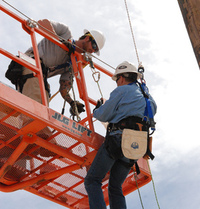
Aerial lifts are potentially dangerous machines. But anything that positions a worker 20 feet or higher in the air creates a certain amount of risk. As a result, lift owners and operators are generally careful to follow proper procedures and maintain their equipment, resulting in an accident rate that is fairly low.
The safety specifications ANSI A92.6 (scissor lifts) and ANSI A92.5 (boom lifts) put the burden for safe aerial lift operation on the user. In summary, these regulations state that even if you rent the machine for a day, you're responsible for understanding how to safely operate it.
Knowing that, the most basic safety features of an aerial lift are the operating manual and safety decals. These provide important information about operating procedures, maintenance, and how to use the corresponding safety equipment.
New lifts come with decals and manuals in place, and the operating manual should be stored on the lift itself. If you're buying a used lift, make sure the manual is included and the important decals haven't been painted over.
Additional safety features
Though nothing can prevent user error or save those who operate machinery outside its intended usage, there are a number of highly-valuable safety features that can prevent many of the common accidents associated with aerial lifts, including:
- High-speed cutout. Most lifts can be driven from the bucket so that even with the lift extended, the operator can move the entire rig. However, the high speed cutout limits the overall speed to a slow crawl when the lift is above a certain height.
- Pothole protection. With this feature found mainly on newer lifts, arms come out to stabilize the unit when the lift is raised. If it hits a pothole while moving, the arms prevent the base of the machine from tipping more than an inch or two, preventing a "catapult effect" that can send an operator flying.
- Level warnings. One of the leading causes of accidents related to boom lifts is uneven ground: even the slightest incline has the potential to destabilize the machine by shifting the center of gravity. Level warnings prevent that by sounding an audible alarm and disabling boom operation if they sense the lift isn't level.
- Guardrails and restraints. Another essential safety feature, guardrails and personal restraints prevent operators from falling. It’s worth noting that these are mandatory and standard on all types of lifts.
- Static straps. If you choose a lift with non-marking tires, it should also have static straps. These straps ground the lift, preventing potentially dangerous static build-up from shocking your workers.
- Manual descent valve. A manual descent valve is another important safety feature. If your lift loses power while a worker is up in the air, someone on the ground can use this valve to safely lower the platform.
- LCD displays. Providing information through diagnostics and sensors, LCD displays improve safety and maintenance operations through up-to-the-minute feedback on operational status.
A large piece of equipment is often only as good as the company that sells it to you – a lot of which has to do with the service contract and routine maintenance. That's why it's crucial to find the best possible seller when comparing aerial lifts.
Choosing Aerial Lift Sellers
Buying an aerial lift involves more than just choosing the right model. You have to choose from several sellers to find one you can work with for the long term. Aerial lifts require annual inspections by a certified mechanic as well as ongoing maintenance, making your relationship with the seller important.
Many sellers have worked in the industry for decades. And finding someone who's been in business that long is a good indication that they'll be in business for years to come and be around to support your purchase.
Look for sellers who are knowledgeable about the product, too. Many aerial lift sellers do more of their business in forklifts and other types of machines, so some may not be as familiar with the ins and outs of aerial lifts. Therefore it's usually smart to choose a seller who sells a range of aerial lifts, preferably including multiple brands.
Service counts
Aerial lifts require ongoing maintenance - lubrication, hydraulic fitting upkeep, and more - so ask sellers about their service policies. Will they schedule regular maintenance visits to top off fluids and inspect the machine?
Also, find out how they'll handle breakdowns. Do they come to you for quick repairs? If your lift needs to go into the shop for more extensive work, will they pick it up and return it? Or do you need to transport it yourself?
Ask about their technicians' qualifications as well. How long have they been on staff? What kind of training do they have? How quickly do they work?
Because of the regular service needs, you'll want to select a seller that is reasonably close to your location. Don't feel like you have to choose the absolute closest seller, but try to find one no further than 100 to 150 miles away, keeping a round trip to around half a day.
A transaction or a relationship?
Don’t underestimate personal reactions in your search. Choose a seller you feel is honest with you and who is easy to work with. Those impressions are often accurate. Better sellers will carefully evaluate your needs, sometimes making site visits to help you make the right decision based on your current needs and projected growth. Always remember: saving $1,000 on your initial purchase by going with the cheapest option is insignificant compared to the ongoing costs you’ll incur over the years.
Check references
Talking to customers can provide insight into a seller's strengths and weaknesses. Ask for customer references -- preferably from customers with aerial lift applications similar to yours.
When checking references, you can ask questions like:
- How long have you been a customer of theirs? How many lifts have you purchased?
- Did you get the right lift for your application?
- Has the seller done a good job with maintenance?
- How was their turnaround for repairs?
- Did they provide training for your operators?
- Would you buy from this seller again?
- What could the seller improve about their operation?
Before you get on the phone with a seller, make sure you know what to pay. Whether you're looking to buy or lease an aerial lift, our pricing guidelines will help you get best machine at the best price.
Aerial Lift Pricing
Depending on how often you'll need an aerial lift, you can buy a new lift, buy a used lift, or simply rent one for a short time. See what other BuyerZone users have paid for new and used aerial lifts.
Businesses with dedicated maintenance departments and substantial facilities to operate are the most likely to purchase a new lift. The increased dependability and lifespan make it a worthwhile investment.
Buying used is a great way to save money on the purchase. But as with any used vehicle, you’re taking a greater chance on the machine eventually breaking down. A good service plan can help offset this risk. And if the lift won't be central to your day-to-day operations, a day or two of downtime won't be a major problem. Buy from a reputable seller and you'll have even less chance of running into problems.
For annual inventory, occasional maintenance work, and other part-time use, renting a lift is the best choice. In addition to saving money, renting a lift removes the burden of maintenance and inspection. The rental firm is responsible for all necessary lubrication and repairs, providing you a lift that's safe and ready to work. If something breaks down, which can happen on long-term rentals, your rental rate should include all required maintenance and repairs.
Aerial lift prices
A standard new 19-foot scissor lift typically costs between $10,000 and $15,000, with 20- and 30-foot models ranging up to $50,000.
Prices for used lifts can be 60% or less than new prices. The same 19-foot scissor lift that costs $11,000 new can be found for $3,500 to $6,000 used, depending on condition and extras. In the same way, a used 30-foot model can cost between $7,500 and $15,000.
Boom lifts are somewhat more expensive. New 30- to 40-foot booms can go for $30,000 to $75,000 on the lower end. Used models range from $17,000 to $40,000. Deluxe 110-foot boom lifts cost well over $100,000 and are often closer to $250,000 depending on the extras. Even used machines in this range run around $80,000.
Vertical personnel lifts are the least expensive and can be purchased new for about $8,500. For the most budget-minded companies, "push-around" models with no propulsion can cost as little as $2,000.
Among the options that have the greatest impact on pricing, 4-wheel drive is one of the biggest. Expect to pay a $5,000 to $8,000 premium to get a 4-wheel drive machine. Also, rough terrain lifts are generally more expensive than their slab counterparts.
Rental prices
Rental prices for standard scissor lifts with a 19- to 30-foot platform height can cost between $90 and $150 per day, $320 to $500 per week and around $600 to $750 per month, with the larger lifts falling on the higher end of the range.
Boom lift rentals are more expensive. A 40-foot boom might rent for $280 to $350 per day or $750 to $800 per week, and $2,000 to $2,250 per month. A 65-foot boom could rent for $400 to $450 per day, $1,000 per week or $3,000 per month.
And finally, 30-foot single-person vertical lifts are the least expensive to rent and can be found for $75 per day or $200 per week.
Warranties
You can expect a basic manufacturer's warranty on new aerial lifts. As with cars, you may get longer warranties on some subsystems, two or three years on the powertrain for example. Used lifts will rarely come with anything more than a 30-day guarantee – and low-end used lifts are often sold "as-is."
Aerial Lift Buying Tips
Don't buy on price alone. As with many industrial purchases, trying to save a few hundred dollars up front can cost you in the long run. Instead, focus on choosing a quality seller and getting a lift that meets all your needs.
Keep up the maintenance. Aerial lifts require some attention to detail: prompt hydraulic fluid and oil changes are a must. Plus, annual inspections by a certified mechanic are required. Safety is too important to let these tasks slide.
Watch out for user modifications. Some rental companies and owners "customize" their lifts by cutting, welding, or otherwise changing the railings or bucket walls. While the work may look strong, it may compromise another element of structural safety or fail to stand up to ongoing use.
Check the odometer or hour meter ... but check more than that. Some sellers replace or reset hour meters or odometers when a machine is refurbished. If the machine looks much older than the gauge indicates, be sure to ask about the real age of the machine.
Measure before you shop. Knowing what limits you have related to the size of your machine is important. Measure doorways, aisles, overhead clearance, and any other restricted areas your lift will need to navigate.