
Buyer's Guide
Introduction to Forklifts
First appearing in the early 1900s, forklifts were initially used to haul luggage around busy train stations. Throughout the past 110 years, the forklift has kept pace with advancements in technology and is now one of the most essential tools for the daily operation of a modern business.
Widely popular for its ability to provide cost-efficiency, a forklift dramatically reduces the time it would take an employee to move the same amount of product by hand with a pallet jack. In addition, they minimize the potential for injury by enabling large quantities of goods or heavy objects to be shifted and placed at heights with the simple flip of a lever.
For these reasons, and a number of other benefits we'll cover forklifts can be found in practically every industry - from manufacturing plants, showroom floors, and distribution centers to loading docks and construction zones.
Though dealers often refer to a forklift by a variety of names, including lift truck, fork truck or even the generic "material handling equipment", they all refer to the same subset of equipment, available in three basic types:
- Smaller electric models that use a built-in rechargeable battery
- Medium-sized propane lifts, fueled by easily-replaceable propane tanks
- Large capacity gas or diesel fueled forklifts, typically reserved for heavy work at lumberyards and construction sites
While they're easy to find, getting the forklift that's right for your situation isn't always as easy. In addition to the power source, you'll need to consider factors that include how much and how high it can lift, how carefully you need to manipulate the load in sensitive areas, and whether you should buy new or used.
Make sure you're in the right market before you start talking to sellers. Whether you're handling standard pallets or specialized loads like pipe, spools, or barrels, if your typical load is less than 3,000 pounds, a pallet jack or hand truck is probably a more economical choice. But for anything from 3,000 to 120,000 pounds and up, a forklift is far more efficient, economical, and safe.
And this BuyerZone Forklifts Buyer's Guide will explain why.
We'll also take a look at the major factors that go into your purchase decision and walk you through the questions to ask before you start shopping. Then, once you know exactly what you need, we can connect you with qualified forklift vendors in your area.
To get started, it's important to have a general knowledge of forklifts, their various components, and what purpose each serves. If you're already familiar with the many facets of a lift, you can skip ahead to the fuel options. If not, here's a quick rundown on each of the major parts.
Common Forklift Parts and Terms
A successful purchase for just about everything begins with a basic set of knowledge regarding the item you're interested in buying. And buying a forklift is no different. Though similar to a standard car or truck, a forklift also includes a number of additional components that require continuous maintenance to work properly.
- Mast: The mast provides the vertical support necessary to raise and lower the load.
- Carriage: An additional support structure, mounting the forks to the mast.
- Load Backrest: The backrest is directly attached to the carriage and prevents the load from shifting backwards, allowing for the movement of pallet-stacked goods or similar objects.
It also serves another critical purpose: it protects the fragile mast cylinder hoses from damage and, more importantly, prevents objects from falling back onto the operator.
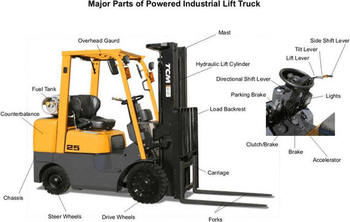
Here's a diagram of some of the unique parts you'll hear a dealer mention. Image source: LiftRight.net
- Forks: Cantilevered arms attached to the carriage used to support the load. Forks come in a range of widths and can easily be adjusted left or right on the carriage to accommodate a variety of needs.
- Hydraulic Lift Cylinder / Lift Lever: Controls the amount of vertical lift that the mast, forks, and carriage are raised or lowered.
- Overhead Guard: A protective framework that prevents objects from falling onto the operator. It should be noted that this grate design is effective at stopping larger objects from getting through but is not as effective at stopping things like sand, dirt, stones, small bricks and similar sized objects.
Though these objects are small, they can cause serious injury to the operator's head and eyes when falling from elevated heights. Therefore many people attach a sheet of steel or heavy-duty clear plastic (which has the added benefit of not reducing the operator's overhead visibility) onto the top of the guard to add a layer of overhead protection.
- Tilt Cylinder / Tilt Lever: Controls the amount of forward and backward lean for the mast, forks and, carriage.
- Drive Wheels / Steer Wheels: Inverse to the wheels on your car or truck, steer wheels are located in back and allow the forklift to maneuver around corners.
In addition to providing enhanced safety in terms of load balance, rear steering is also used for moving objects while driving in reverse, a common situation when the load obstructs the operator's visibility. The drive wheels are mounted in a fixed position and do not turn on radius.
- Counterbalance: Weight installed by the manufacturer that provides stability to the lift when transporting or lifting heavy objects.
It's important to factor in the long-term cost of a lift. And a lot of that is dependent upon the type and quantity of fuel required. So your first step in the purchase process is figuring out which of the following fuel options is best suited to your business.
Determining Capacity & Height Requirements
Before you start comparison shopping, ask yourself:
- How heavy and what size are your typical loads?
- How high do you need to lift the load?
- Will you be using the forklift indoors, outdoors, or both?
- How wide are your narrowest aisles? And how much room do you have to maneuver in common work areas?
- How many hours per day will the lift truck be used?
With these answers in mind, the following guidelines can help you determine exactly what kind of forklift you need.
Capacity
Forklifts are categorized according to their capacity - the measurement of how much weight they can lift. Commonly starting with a capacity of 3,000 lbs and supporting up to 120,000 lbs, the most popular models are those rated from 3,000 to 7,000 lbs and from 8,000 to 11,000 lbs., with each model supporting a 2,000 to 3,000 pound differential in weight-carrying capacity. Though there are a number of higher-rated models for heavy-duty operation, these two options make up the bulk of the market.
Your average load will affect the capacity you need.
Forklift capacity is usually based on a 24-inch "load center." This means the distance from the center of the load to the vertical part of the forks should be no more than 24 inches. An easy way to visualize this is to imagine a crate that is 2 feet wide and 4 feet long. When that crate is placed on the forks, it's considered "properly weight loaded" in a horizontal position in relation to the driver. If loaded vertically, meaning the box would protrude off the end of the forks, it shifts the center of balance and causes the lift to become unstable.
If your loads are unusually long or high, the forklift won't be able to safely lift as much without risking a tip-over.
- BUYING TIP: Knowing the typical dimensions and weight of your loads will allow you to work with the salesperson to determine the exact capacity you need.
And don't forget to factor in load variation. If you constantly produce identical pallets, you know the exact capacity you need. But in a mixed environment, or one where the load sizes change over time, you may want to buy a truck with more capacity than you currently need to account for future increases, thereby maximizing your investment.
Height
A close second to capacity is height. If your primary use for the forklift is loading and unloading trucks, you may not need much height at all. But if your facility, showroom, or warehouse has shelves or racking positioned at 30 feet, you'll need a lift that can safely clear that reach.
Unlike load capacity, your height needs are unlikely to change over time, barring new construction or major renovations. So measure for the max height you currently need and shop with those specs in mind.
New vs. used
Deciding between a new or used forklift is a good place to start narrowing your options. And here's a basic operational rule to follow: if you're going to be using your forklift more than four hours a day, invest in a new lift truck.
The reason being, forklifts that are used more than four hours a day are a major part of your operation. And with this much use, the operating and maintenance costs on a used lift truck can quickly wipe out the initial savings you gained.
If you plan on using the lift truck only a couple hours each day, or even less frequently, you'd probably benefit from buying a used truck.
Many dealers offer both new and used forklifts, enabling you to easily compare prices. Make sure to inquire about the difference in service plans and warranties between new and used models.
When a dealer takes back a used lift truck at the end of a lease, they usually recondition it with a new paint job, new tires, a thorough engine tune-up, and any other mechanical repairs that need to be made. So you can feel reasonably confident in the condition of a used truck. Just make sure it comes with a warranty that fits your needs as well as the age and wear of the forklift itself.
"As-is" trucks can save you even more money, but could have chipped or scratched paint, worn tires, and may not be in the best shape mechanically. Unless you have a relationship with the dealer, it may be a good idea to have someone who knows forklifts take a look at an "as-is" model before you buy. Because if it breaks down the day after purchase, you're going to be the proud new owner of a pricey piece of warehouse decor.
It's important to factor in the long-term cost of a lift. And a lot of that is dependent upon the type and quantity of fuel required. So your next step in the purchase process is figuring out which of the following fuel options is best suited to your business.
Forklift Fuel Choices
The two main options for powering your forklift are electric - powered solely by an on-board battery - or internal combustion (IC), which uses a traditional engine that runs on one of several types of fuel.
Electric
Electric forklifts are powered by large, heavy lead-acid batteries - the same kind found in your car, but considerably bigger and more powerful. The batteries typically provide enough power for one standard eight-hour shift, which translates into 5 or 6 hours of constant usage.
There are two primary advantages to electric-powered forklifts:
- They produce zero emissions. If you are going to be using your lift indoors, this is a very important consideration.
- Economical fuel. Electric lifts have a lower cost per hour of operation than any of the internal combustion models. This helps offset one of their disadvantages... a higher price tag. New electric forklifts can cost 20% to 40% more than their IC counterparts.
Additional advantages of electric forklifts include quieter operation - a huge benefit indoors - and no fuel storage requirements. Plus, because they have fewer moving parts and are often used in cleaner environments than IC trucks, they also tend to have a longer lifespan.
Forklift batteries and fast-charge technology
The biggest downside of electric lift trucks is the battery downtime. Charging a forklift battery takes 8 hours, plus 8 hours to cool before it can be used. Due to this slow process, if you need forklifts for two or three-shift operations, you have to buy extra batteries so you can always be charging the next one.
This requirement leads to other disadvantages, including the need for a battery charging station that's centrally located in a dry, ventilated, and temperature-controlled room. And if you have multiple batteries, you're also going to need special cranes to change the batteries.
Recently however, lift truck manufacturers have introduced fast-charge technology, eliminating a number of these pricey inconveniences. Fast-charge and opportunity-charge capabilities have become part of every conversation related to the purchase of an electric truck. At the same time, sellers would caution you to conduct power studies - some even citing them as "crucial" - to ensure one of these charging techniques is not misapplied to your operation.
Originally created for use with electric cars, fast-charge technology allows you to charge a battery in less than 90 minutes while the operator is on a lunch break or between shifts. The fast-charge option also reduces the overall cost of the forklift itself by eliminating the need for additional batteries, a dedicated room or area for charging, and the staff required for the task.
The primary difference between a standard battery and its fast-charge counterpart is the addition of upgraded cables and double inter-cell connectors, the components responsible for facilitating a higher rate of charge.
But no new technology comes without a bump in price, at least initially. You can reportedly expect to pay anywhere from 10% to 20% more than a standard battery for the fast-charge option. But when you factor in the cost of downtime, extra equipment, floor space, and the staff necessary to charge a standard forklift battery, the added cost may be worth it.
Regardless of the battery you select, electric forklifts are not designed for outdoor use. Though some can be used on a loading pad or smoothly-paved parking lot, none of them can be used in the rain.
| Internal Combustion | Electric | |
|---|---|---|
| Maximum available capacity | 35,000 lbs. or more | 10,000-15,000 lbs. |
| Power source | Gasoline, diesel fuel, liquid propane gas, or compressed natural gas engine | Battery |
| Costs | Lower purchase price Higher operating costs |
Higher purchase price Lower operating costs |
| Best used | Outdoors (Propane: Indoors or Outdoors) |
Indoors |
| Typical Applications | Lumber yards, construction, loading docks |
Indoor warehouses, manufacturing |
| Refueling time | 5-15 minutes | 16 hours to recharge a battery; 20-45 minutes to change batteries |
Internal combustion
Internal combustion engines run on a variety of fuels: gasoline, diesel fuel, liquid propane gas (LPG), or compressed natural gas (CNG). The main benefit of IC forklifts is their ability to be refueled on the fly. Simply fill it up at a gas pump or load a new LPG canister and you're ready to continue working. Plus, their price points are the inverse of electric - they're cheaper to buy but cost more per hour to run.
Despite the operational costs, only IC forklifts are capable of handling the largest loads. So if you require more than 12,000 lbs of capacity, you definitely need an internal combustion engine. IC forklifts also stand up to certain types of abuse better than electric lifts, such as using a forklift to push or tow loads, instead of lifting and driving. In addition, they usually have better acceleration and higher speeds.
Of the internal combustion models, only propane-fueled lifts can be used indoors. And even they require very good ventilation. Gas and diesel-powered models are strictly for outdoor use only. For indoor/outdoor use, duel fuel systems are available that let you switch between LPG and gasoline.
- BUYERZONE SELLER TIP: Smaller lifts like stock-pickers and pallet jacks are intended almost solely for indoor use only. Therefore they are not available as diesel or fuel-based models due to the resulting fumes and health hazards that setup would create. Save yourself some embarrassment by knowing in advance: these types of lifts are electric only.
Lift truck fuel costs
Generally speaking, fuel costs are highest for gasoline and lowest for diesel, with LPG falling somewhere in the middle. Fuel costs vary considerably from state to state and fluctuate dramatically depending on the price of oil and other contributing factors. So don't forget to investigate this cost relative to your area before deciding which option is best for you.
Want quick, valuable tips for buying forklifts?
Download our free PDF - the BuyerZone 5 Minute Guide to Purchasing Forklifts.
Before deciding, you should know there's a disadvantage to some IC fuel systems. And it's a rather costly one.
Certain IC equipment, primarily those catering to gasoline and diesel fuel, requires you to have storage tanks and pumps. In contrast, LPG only requires space for the storage of spare tanks, which is usually managed by a propane vendor. This level of customization often dictates the choice between gas, diesel, and propane as some business owners may be unwilling to spend money on a completely new setup.
EPA regulations
Manufacturers must ensure that their IC engines are compliant with state and federal emissions regulations, specifically EPA Tier 1 through Tier 3. These laws are already in effect and the more-stringent Tier 4 hydrocarbon (HC) limits are being phased in through 2015. Check for this conformity when choosing your forklift, especially when considering used equipment.
For more information on emission standards for on-road and non-road vehicles and engines, review the EPA's Reference Guide.
Although they have an established track record of performance and cost-savings, electric and IC models are not your only option. Hydrogen fuel cells are growing in popularity due in large part to their durability and emission control. Don't settle on a power source before exploring what green fuel options may be able to do for you.
Green Forklift Power Options

Hydrogen fuel cells provide the advantages of electric power - zero emissions and quiet operation - with the ability to be refueled as quickly as diesel or gasoline engines, with no recharging time.
When used to power a lift truck, hydrogen provides consistent power during operation, reportedly producing a continuous power rating of 8 kW and a maximum output of 32 kW in some models. Another significant benefit is that the hydrogen system, unlike a traditional forklift battery, does not decrease in performance when nearing change-out or recharge time.
This durability extends to their performance in extreme environments as well. Hydrogen-powered fuel cells are not impacted by temperature, making them ideally-suited for environments such as coolers, freezers, or arid conditions.
Best of all, hydrogen-powered batteries are environmentally-friendly. They do not involve lead-acid battery storage or disposal and are therefore a technology many businesses may look to in the coming years for their green footprint, as well as the cost savings they provide associated with disposal.
But this particular aspect of their cost-effectiveness is not the final word. Many current users have been able to make the transition to hydrogen only with the help of government grants and rebates, offsetting the often considerable costs of equipment.
Though the technology works well, some sellers question whether there can be sustained cost-savings in the long term as the maintenance of the fuel cells is much more involved than most end-users expect. In addition, the cost of replacement parts and fuel cells is still quite high.
Though still in their infancy, some fuel cell forklifts are already in use at major automotive factories and other companies with large fleets. But should the subsidies cease or "green" operation falls out of favor, this technology may struggle to survive unless a cheaper source of hydrogen is developed, according to our pro sellers.
Now that you know your lift truck capacity and fuel requirements, there are some other options to consider -- most importantly, the tires. Your intended usage will greatly impact your purchase decision in this area.
Choosing Tires & Other Lift Truck Options
Once you know the lift truck capacity and fuel type that are best-suited to your company's needs, there are other options to consider. Most important among these options are the tires. Also, your intended usage will greatly impact your purchase decision in this area.
Tire options
Lift trucks have three types of tires to choose from:
1. Cushion tires: Made of solid rubber, these tires are pressed directly onto the wheel. Cushion tire forklifts are constructed with a smaller chassis and sit much lower to the ground than their pneumatic counterparts. This provides a major advantage in maneuverability, giving them a much smaller turn radius, but is also the reason they are suited primary to indoor use only. With such little ground clearance, the lift is prone to getting hung up on uneven pavement and other obstacles outside.
Lifts with cushion tires are also usually less expensive and are easier to find, both new and used, than pneumatic forklifts. So if you need a lift primary for internal applications, cushion tires are probably the best choice.
- BUYING TIP: If you're buying used, pay attention to the safety bar on cushion tires. If the safety bar is readily visible on the sidewall, the tires need to be replaced. For all others, pay attention to the level of wear. When it reaches the top of the imprint of the tire, they need to be replaced. Once the tread reaches that point or the safety bar, the lift's carrying capacity is reduced by almost 50%. Plus, for cushion lifts, the tire is the only source of shock absorption. So once the tires exceed the optimal range of their lifespan, you'll get a pretty bumpy ride.
2. Pneumatic tires (solid/air): For heavy-duty lifting or outdoor operation, a gasoline or diesel lift truck with pneumatic tires is the most common choice. Pneumatic tires are longer and wider than cushion tires and are either solid or filled with air, similar to a standard car or truck tire.
As the name implies, solid pneumatic tires are made of solid rubber. Practically bulletproof, solid tires won't pop, puncture or go flat because they're manufactured from 100% rubber, which makes them great for construction zones, lumber yards, recycling centers, and locations that have their surface littered with metal shards, nails, and potentially damaging items. This level of reliability also makes solid tires more expensive than air pneumatic tires, and justifiably so.
Similar to solid pneumatics, air pneumatics work well outdoors on asphalt, gravel, and even unpaved terrain. But just like the ties on your car, they can be punctured. So the work area has to be relatively free of sharp objects. A final option for air pneumatic owners is to fill their tires with foam. This provides a little more durability over standard air and also gives a smoother ride when compared to solid pneumatic tires.
3. Polyurethane: Designed to be pressed onto the wheel of the forklift, polyurethane tires are easy to install and best suited for use with electric forklifts. They're popular for the excellent traction they provide but can only be used indoors due to their incompatibility with rough outdoor terrain. They also feature a low rolling resistance that reportedly prolongs their lifespan.
Tire mounting: press-on vs. standard
Forklift tires are either press-on or standard mount. Press-on (or "cushion") tires are a little easier to install but they're not as durable and may not stand up to the rough outdoor terrain often found at construction sites and similar locations.
For this reason, press-on tires are typically used only on electric forklifts, reach trucks, order pickers, or forklifts designed mainly for indoor use. In contrast, standard tires are mounted just like a car tire and perform with the same level of reliability, making them the most popular choice for forklifts requiring outdoor/indoor or heavy-duty use.
A quality forklift seller will be able to provide the best guidance on tire selection related your specific application.
Aisle width and lift truck size
In a warehouse setting, the size of the lift truck may be an issue. Standard lift trucks need aisles that are 11 feet wide (or wider) to be able to turn around and operate efficiently. For aisles that are 8 feet to 10 feet wide, you'll need a narrow aisle (NA) truck. For even smaller aisles, all the way down to 6 feet wide, you'll need a very narrow aisle (VNA) truck.
These narrow aisle trucks have forks that are turned at a right angle, so they can drive straight down the aisle but pick up loads to the side.
Additional tech enhancements and features to consider
Though not as critical to operation, a number of other considerations often factor into a forklift purchase. Typically addressing issues of operator safety, comfort, and effectiveness, these include:
- Safety equipment. Back-up beepers, flashing amber lights, headlights, and other safety features are sold standard with most forklift trucks. State regulations vary, but we recommend you make sure they're either included or able to be added.
- Ergonomics. They may seem like an amenity, but for employees who use your lift truck all day long, adjustable seats and comfortable controls can reduce the risk of repetitive stress injuries and make for a more productive workforce.
- Attachments. You can tailor your lift truck to better handle specific types of materials, including tools to pick up rolls of cable or steel, tongs for handling 55 gallon drums, flat panels for lifting items that aren't on pallets, and more. Most attachments are standardized so they can be used on any forklift. So if you only need to move odd-shaped loads occasionally, you may be able to buy one attachment and use it with any of your lift trucks.
- Sideshift. This popular option enables the operator to move the load left and right without moving the truck, allowing much more precise placement of loads.
- Sidewinder. Sidewinder models enable the operator to move in any direction, breaking free of the traditional rear steering design. This model also eliminates traditional pneumatic or solid tires, running instead on a series of rollers that can change direction and even roll over obstacles (up to 3 inches) like a mini tank.
- Tilt mast. The ability to tilt the mast and forks forward and back greatly simplifies loading the truck on uneven ground. Slightly tilting the mast back also provides greater stability when moving a loaded truck, helping to ensure the load won't go flying forward if the operator has to stop quickly.
In addition, don't forget about guidance systems and computerized controls. Some manufacturers offer a vision-based control system which enables independent loading. A camera connected to an image acquisition and processing circuit allows the computer to control the prongs and automatically pick up the load.
Other options include guidance systems that employ the use of lasers and magnets. The laser system relies on retro-reflective targets positioned throughout a workspace to bounce the laser beam off of and back to the forklift. In doing so, the lift can determine its exact location.
The magnet system has a series of magnets embedded within the floor of the workspace similar to a train track. The forklift itself has corresponding sensors to locate the magnets and stay on "track" within a designated location.
With your requirements in mind, it's now time to find a forklift seller that can meet your needs for price and service. This next step will tell you how to find the one that's right for you through a simple process of elimination.
Choosing a Forklift Seller
When you choose a forklift, you're also choosing a seller. The seller provides the service and support to keep your lift running smoothly. That's why it's so important to find one who is reputable, stable, and can deliver top-notch service.
When evaluating forklift sellers, it's a good idea to compare a number of potential candidates side-by-side. This practice enables you to weed out any sellers who aren't compatible with your needs right up front. It also makes the selection process that much easier by revealing which ones provide the products and services most important to you.
Quality lift truck sellers will typically possess the following traits:
- Open-door policy: take a tour of the seller's facilities, if possible. Check out the manufacturing areas (if applicable), customer service department, and warehouse. Simply seeing these areas can give you a good sense of their capabilities.
In addition, pay attention to the employees - all of them, not just the one giving the tour. Do employees make eye-contact? Do they seem happy and willing to help or answer questions? Do you get the sense they're glad to be working there? - Dependable reputation: Credibility matters. Unlike a laptop computer or desk lamp, a forklift is a major purchase for just about any business. Be on the lookout for a forklift seller with a strong work ethic and approach to business. When talking to others, see which values (especially those related to service and quality) sync with yours... and more importantly which ones don't.
- A consultant, not a salesperson: a good forklift seller will take a consultant's approach to your purchase, striving to find the perfect fit for your needs and then explaining how their lift is ideally positioned to improve the efficiency of your operation. They may even be able to offer tips on extending the tires and other components on the lift that routinely wear faster than others.
sellers who simply try to sell you as "big" as possible or pressure you into unnecessary upgrades should be avoided, as the forklift could end up being far more costly to run and maintain in the long-run.
Some important questions to ask when evaluating forklift sellers include:
- How long have you been in business?
- What kind of parts inventory do you keep on site?
- How many technicians do you have?
- How many forklifts similar to the one I'm interested in have you sold in the last year?
- Do you provide on-site service?
- What are your service hours in case of breakdown? 24/7? (This may be important to you if you plan on running lifts 2 to 3 shifts in the course of a day.)
- Do you have guaranteed response times when a piece of equipment breaks down?
- What brand or brands do you specialize in and why did you select this particular brand?
- How much of your business is based on referrals?
- What kind of insurance do you carry? (If they don't have proper worker's comp, one of their technicians who gets hurt while repairing a forklift at your facility could fall under your insurance.)
Forklift seller referrals
Since forklift sellers typically have exclusive territories for the brands they sell, it can be fairly easy to get a sense of the firm's general reputation. Talking to other businesses in your area can be a great source of insight into a seller's strengths and weaknesses.
Quality forklift sellers will be more than happy to provide a list of their happiest customers. While not every reference may be applicable to your situation, having at least one reference with forklift applications similar to yours is a good sign. When checking references, inquire about all phases of purchase, delivery, and service.
Ask questions like:
- How long have you been a customer of theirs? How many forklifts have you purchased?
- Did you get the right forklift for your application as the result of their consultation?
- Were there any problems with the initial purchase?
- Has the seller been responsive to your inquiries post-purchase?
- Has the seller done a good job with maintenance and repairs? What do you think of their service plan?
- Would you buy from this seller again?
- What could the seller improve about their operation?
Choosing a rental provider
If you decide to rent first, you might want to consider a third-party equipment rental company instead of a seller. Rental companies typically offer multiple brands of forklifts. By trying out a different lift truck over the course of a few months, you'll get a much better sense of which brand and type is best for your application.
Your final step before committing to a seller is the most fun: test drive.
Taking a Forklift Truck On a Test Drive
Knowing the specs and options is only the first step in making a good purchase. Once you've narrowed your choices down to a few models, ask the vendors for in-house demonstrations.
At the very least, sellers will bring the model you're considering to your location and let you use it for an hour or two. In many cases, the seller will let you keep the truck for 1 to 3 days, giving you a real chance to put it to the test in a live environment.
A full day or more of using the truck will give you the best idea of how it fits with your specific application. Personal preferences about the controls and ergonomics can play a big role in your decision, and having the truck at your location gives you the chance to include more of your lift truck drivers in the decision.
In addition, forklift vendors will help you evaluate your facility and requirements. By measuring doorways and aisles and examining your typical loads, they can help you choose a forklift best suited to your particular needs.
Rent to evaluate
Another way to evaluate a particular model for a few weeks, a month, or even longer is to rent it. If you aren't familiar with the different brands and types of lift trucks, this is a great option to consider. Renting a forklift for an extended period of time can provide you with a sense of whether its capabilities are appropriate for your needs without the pressure of a long-term lease or major investment.
Plus, with a rental lift truck, you never have to worry about maintenance or repairs. If anything goes wrong, the rental company will simply repair or replace it.
- RENTAL TIP: Be sure to ask the seller about repair response times and whether a temporary replacement lift is provided in the interim to ensure your operation doesn't come to a complete halt in the event of a breakdown. These terms should be clearly stated in your rental agreement.
On an item of this size, there's always room for negotiation. So keep these averages in your back pocket when considering forklift pricing.
New and Used Forklift Pricing
There's a wide range of quality and extras when it comes to buying a forklift. So it's hard to set a definitive price. We'll give you some general guidance in terms of cost range, as well as examples of what our buyers have paid, but there a few points to keep in mind:
- Similar to standard cars and trucks, the manufacturer matters. Top-tier brands are built to a specified level of quality, often with more demanding specifications in mind for particular applications. As a result, these vehicles (and forklifts by extension) perform more reliably.
- Buying mid- or lower-tier brands can be an excellent way to save money but it may not adequately meet the demands of your business. Even worse, these lifts can actually cost you more in the long-run.
- As a general rule, the more punishing the environment and usage, the more you should expect to pay for a dependable lift.
- Geography also plays a big part, especially if you're buying used, with inventory and availability that continuously fluctuate. So the price a buyer in one part of the country pays may not reflect the costs you can expect to see elsewhere for the exact same machine.
Forklift price ranges
Generally speaking, electric forklifts cost more than internal combustion lifts with comparable specs. But features, brand names, and other factors often result in exceptions.
A 5,000 lb forklift is the industry standard. New electric 5,000 lb forklifts typically retail for $20,000 to $25,000 plus $2,800 to $5,000 for one battery and a charger. For this reason, electric forklifts sell quickly in the used market, where the cost is often half that of a new lift. In addition, you'll probably require a battery transporter and can expect to pay anywhere from $3,000 to $6,000 and up, depending on its weight-rating.
A 5,000 lb internal combustion (IC) forklift starts at around $20,000 and can cost up $36,000 or more, depending on the options you choose.
At the larger end of the scale, you're primarily looking at IC forklifts. Due to Tier 4 EPA requirements, a 10,000 lb diesel lift can go for $40,000 to $60,000. High-end lifts, with capacities of 35,000 lbs or more, cost $100,000 and up.
Want more specific examples? Take a look at what our users paid for new, used, and leased forklifts.
Operating costs
The real cost of your forklift goes far beyond what you pay up front. Hourly operating costs can be an unpleasant surprise if you're not prepared for them. So listen up! These costs include fuel, energy, maintenance, and supplies like oil, batteries, filters, or fuel cells. Plus, you have to factor in the often considerable cost of labor required to service the truck.
Operating costs increase with the size of the truck and are exponentially higher for IC trucks. In fact, depending on your geographical location, the operating cost of an electric forklift is only 10% to 15% of its IC counterpart.
Consider the following example. Let's assume our year includes a total of 250 work days. Depending on the efficiency of the charger you use and the cost of electricity in your area, the cost of charging a standard industrial battery would be about $3 per charge.
At the same time, you'd pay about $30 to fill a 7 gallon diesel tank and $25 to $35 to fill a 33 lb propane tank. Assuming two fuel replacements each day, this would equate to a yearly fuel cost of $1,500 for electric, $15,000 for diesel and about $12,500 for propane.
With this in mind, we can break down your hourly cost to: 75 cents per hour for an electric lift, $7 to $10 per hour for a diesel truck and $6 to $8 for an LPG lift truck.
But also keep in mind, these estimates don't account for lift maintenance - another area where electric units beat out IC forklifts. By some estimates, IC lifts require DOUBLE the amount of maintenance when compared to an electric forklift due to the greater number of moving parts requiring service on an IC model.
Factoring in parts and maintenance can see your costs rise from $3 per hour to well over $30 per hour, depending on the lift.
Used equipment
Buying used equipment can save you quite a bit up front. But even a used forklift is still a significant expense. A used 3,000 lb electric forklift might go for around $5,000 to
$10,000 - less than half the cost of a new one. A 5,000 lb IC forklift that might cost $28,000 to $40,000 new could cost $8,000 to $16,000 in the used marketplace.
- BUYING TIP: If you're using your forklift more than four hours a day, you may quickly find that the costs of downtime and repairs cancel out the savings of a used lift. For full-time usage, it's probably worth the extra initial cost to buy a new lift truck, and may even be cheaper. Plus, new lifts are backed by original manufacturer warranties and may include better service plans with a quality seller.
Forklift leasing, financing, and long-term rentals
Because of the high initial cost, almost all forklifts are either leased or financed. Some manufacturers provide financing and forklift leasing through their sellers. In other cases, the seller may have an arrangement with a third-party bank or leasing company.
When manufacturers subsidize a forklift loan or lease, they may offer very favorable terms. Nevertheless, if you're dealing with a third party, compare the financing terms to those you could get through own bank to ensure you're getting the best deal.
Long-term rental is another alternative. Usually defined as a rental for more than 12 months, long-term rentals differ from leases in that they can be canceled any time after the minimum rental period expires. Featuring a lower monthly rate than short-term rentals and typically including all maintenance, long-term rentals can be an economical choice for temporary projects or contractors. If you're going to use it for the full term, a standard lease is usually more cost-effective.
Warranties
The greater the number of in-service hours your forklift logs each week, the more susceptible it is to wear and damage. A lift truck that works 10 hours or less each week is safe with a lower service package and warranty than a lift in service 20 or more hours per week.
In addition, the work environment should also factor into your purchase decision for warranty and service packages. Construction zones, industrial factories, and other locations that routinely haul heavy loads or have corrosive elements in the work environment should be on the lookout for a more comprehensive warranty that offers a higher level of coverage for more components over a longer period of time.
Service plans
To protect their investment, the majority of forklift buyers choose a preventative maintenance (PM) plan. These plans cover oil and filter changes, transmission servicing, and general check-ups at regularly scheduled intervals. Unless you have an in-house mechanic to perform these maintenance tasks after every couple hundred hours of operation, it makes sense to lean on the seller's expertise.
Many quality sellers offer complete maintenance plans that cover any breakdown or repair that's needed. This type of plan often includes:
- Basic preventative maintenance on a bi-monthly or quarterly basis
- Complete preventative maintenance and/or full tune-up at least once per year
For a new forklift, you probably won't need this type of coverage as you'll have very few breakdowns in the first couple of years. But on older equipment, it may be a useful insurance plan. At the same time, if you're buying older equipment to save money, the cost of the extra coverage could wipe out the savings you're trying to achieve.
Cost varies by region. But in general, you can expect to pay around $40 to $50 per month or around $500 to $550 annually, based on quarterly service intervals, for a service agreement with a reputable seller.
In addition to cost, there are a few other buying tips we've compiled through customers and sellers alike that can help you get the most machine for your money.
Helpful Forklift Buying Tips
- Think of the user! This is a basic consideration, but it can easily be overlooked. The forklift should be comfortable for users to drive for long periods of time, with a supportive seat and accessible controls.
- Keep on top of training. OSHA training may seem like a hassle and expense since the rules are not strictly enforced. But if you have a forklift accident, OSHA will investigate your training and licensing procedures and can levy significant fines if you have not followed all the procedures.
- Know your capacity. Attachments like sideshift, adjustable forks, and spool handlers reduce the load capacity of forklifts. Every forklift should have a capacity plate, often found on the front side of the steering column behind the mast, detailing what its capabilities are in its current configuration.
- Try multiple brands. If you aren't familiar with forklifts, we strongly recommend renting a couple different models for a month or so. You'll get a much better sense of the strengths and weakness related to each model and discover pretty quickly which ones are suited to the demands of your business.
- Stick with one brand once you decide. If you plan to buy multiple lift trucks, standardizing with one brand gives you the advantage of dealing with a single seller for all your warranty and repair needs. Your operators will also benefit from not having to learn the controls and handling quirks associated with multiple lifts. In some cases, this may not be possible if you end up needing specialized machines that aren't produced by your chosen manufacturer.
There are a number of safety issues to be aware of. If your seller doesn't provide in-house training, they should be able to refer you to a company who can. Here's what to be on the lookout for.
Forklift Training and Safety
According to our professional sellers, forklift operator training is the one area many customers typically invest the least in. As a result, it's also the area that ends up costing them the most.
The Occupational Safety & Health Administration (OSHA) has very specific rules about forklift operator training and licensing. Operators must pass classroom training and a driving test before being licensed, must be over 18 years of age, and must be evaluated and recertified at least once every three years.
Despite what you may find on Google: you cannot be certified to drive a forklift by an online vendor!
Though you can receive a majority of your forklift instruction online, OSHA certification requires training that consists of:
- A combination of formal instruction (e.g., lecture, discussion, interactive computer learning, video tape, written material)
- Practical training (demonstrations performed by the trainer and practical exercises performed by the trainee)
- Evaluation of the operator's performance in the workplace
In addition, there are two types of training, OSHA 10-hour and OSHA 30-hour. The extended version is geared more toward foremen, supervisors, managers, safety committee members, safety staff, and other individuals who are responsible for workplace safety.
Many sellers provide training at their location if you only have a couple of operators. For larger groups, they may be willing to organize a class at your location. Costs range from $60 to $200 per person and vary by location and number of participants.
- SAFETY TIPS: Though this guide does not address load composition, handling, and other issues related to a safe work environment, these are all worth checking into.
- DAILY CHECKLIST: Here's an OSHA-approved daily checklist for all lift operators to complete before beginning their shift. In addition to enhancing the safety of your operation, it also makes a great checklist for evaluating the quality of used lifts you may be interested in purchasing!