
Forklfit Attachments Add Additional Functions
Any good carpenter will say you've got to use the right tool for the job. And it's no different for lift truck attachments.
While forks are the most common attachment, they're not always the best solution for every application. In pursuit of higher productivity, less product damage and reduced worker injuries, many loads require an attachment other than a fork - clamps and push/pull units, for instance. And even if forks are the tool of choice, attachments such as side shifters and fork positioners are valuable aids for improving load handling.
Additionally, attachments protect operators from ergonomic stress by keeping them on the seat of the truck rather than lifting, pulling or tugging loads that couldn't be moved with conventional forks. Attachments make proper handling of the load more convenient for the operator, who is then more likely to handle and transport loads correctly-reducing product damage.
As for the future of lift truck attachments, suppliers are working to develop higher levels of monitoring attachment use through bar coding and radio frequency identification (RFID) tags.
And, yielding higher productivity is ultimately what lift truck attachments are all about. Here's a look at the most common technologies applied to pallet-based and pallet-less load handling.
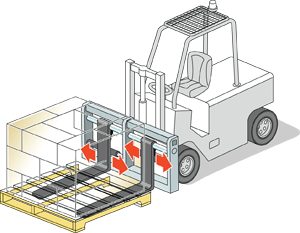
Side shifters allow operators to shift the forks 4 inches to the left or right.
Side shifters allow operators to shift the forks 4 inches to the left or right.
Fork Extensions
Blade extensions are available from 48 to 60 inches in length. Extensions must be purchased to match the width of the existing blade. There are two safety issues to consider when using extensions. First, the extension can only be 1.5 times longer than the fork's usable length. Second, extensions should not be used in cases where the heaviest portion of the load is on the outer ends of the fork.
Special Application Forks
You will find a variety of forklift forks available for custom requirements:
- If you frequently move drums or barrels, blades are available with notches for easier pickup.
- Forks with stainless steel coatings should be used in food industry applications. Stainless steel provides a sanitary surface.
- Spark retardant blades are designed for safe use in locations where explosive hazards exist.
- A rounded top on a fork blade will allow for easier moving of coils or wheels. The forks cradle the coil and prevent it from rolling from side to side.
- Blade covers made from polyethylene will protect items from scratches. If you use any blade covers, remove them every day to inspect the forks.
- Roller forks have a series of roller cartridges that allow loads to slide onto the forks easily. These forks are not for use with heavy loads and caution is required to prevent loads from sliding during transport. Angle the front end of the forks up slight to stop the load from shifting.
Pallet handling attachments
Side shifters
The most common attachment today, the side shifter operates with a standard pair of forks. As the name suggests, the attachment allows operators to shift the forks 4 inches to the left or the right to align them perfectly with pallet notches when picking up a load.
By adding this additional dimension of movement, wear and tear to the truck is avoided, as operators can reposition the forks rather than reposition the truck by maneuvering it repeatedly in forward and reverse. Also, side shifters cut down on pallet damage since truck repositioning is sometimes considered optional by operators. Side shifters are available as both single and double units, capable of handling one or two pallets at the same time.
Fork positioners
With the variety of pallet dimensions out there, each with different pallet notch spacings, it would be impractical to have multiple lift trucks designated to handle each size. It would also be a very timely undertaking for an operator to have to climb down from the cab and manually adjust the fork spacing before every pick up.
Fork positioners, usually hydraulic-powered, are a solution. This device automatically adjusts the distance between the forks to handle an infinite number of pallet sizes, without the operator ever leaving the seat of the truck. In addition to the time savings, fork positioners also reduce the potential for back injuries or pinched fingers that could result from manual adjustments.
Multiple pallet handlers add a second of third pair of forks to the truck.
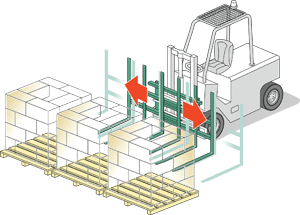
Multiple pallet handlers add a second of third pair of forks to the truck.
Multiple pallet handlers
Multiple pallet handlers can double or triple lift truck productivity by adding a second or third pair of forks to the truck. Some attachments handle loads that are two pallets deep.
By allowing operators to pick up more than one load at a time side by side, a greater number of pallets can be transported throughout the day. Multiple pallet handlers are most frequently found in high-volume operations such as beverage and food handling.
These attachments do present some limitations in horizontal clearance, limiting their access to certain aisles or other areas. However, some models feature retractable forks that permit single load handling and can travel through narrow aisles and doorways.
Pallet less handling attachments
Clamps
Clamp attachments literally clamp opposing sides of a load, applying a sufficient amount of pressure to lift the load in a controlled manner without crushing or dropping it. Used in a range of applications, clamps handle loads that simply aren't transportable by pallet.
Flat surface carton clamps are often used in the appliance industry to move high-bulk, low-weight items like refrigerators, washers, dryers, ovens, dishwashers and more. They're also used to move unit loads of beverages stacked without slip sheets or pallets.
Concave surface paper roll clamps are used in the paper and printing industries to move large rolls of paper throughout a facility. Clamps are also used to position rolls on equipment that converts raw paper into consumer goods like paper towels, toilet paper and tissues.
Carton and roll clamps grab opposing sides of a load with enough pressure to move the load in a controlled manner without crushing or dropping it.
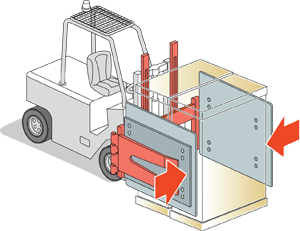
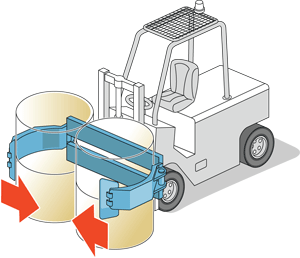
Carton and roll clamps grab opposing sides of a load with enough pressure to move the load in a controlled manner without crushing or dropping it.
Rotators
This attachment features forks mounted on a rotating apron that turns anywhere from 180 to 360 degrees. Rotators are most often used in operations where bulk bins or containers store and transport large volumes of small items. Once the truck has delivered the bin to its destination, the rotators turns to dump the contents out into another hopper or processing station.
These attachments are used extensively in scrap metal applications. Other uses include food and wine processing. Rotators are part of the sorting and production process as bins of fruits and vegetables are received from the fields and then poured into processing equipment.
Push/pull units clamp on to the lip and pull the load onto a set of wide, low profile forks for transport.
Push/pull units
Push/pull attachments work with loads on cardboard or plastic slip sheets with a lip. The attachment clamps on to the lip and pulls the load onto a set of wide, low profile forks for transport.
Once the load reaches its destination in the warehouse or on the trailer, it is then pushed off the forks by the attachment. They are most often used in situations where a facility has elected to eliminate pallet usage to cut costs. These attachments are also often found in food-processing applications, where users have replaced pallets with slip sheets for hygienic and sanitary reasons.
Ready to Compare Forklifts Price Quotes?