
Rough Terrain Forklift - Power and Versatility
Taking your company to the next level requires the right tools. Using the right equipment provides a boost in scope and profitability. One of those tools is a rough terrain forklift. There are many options when looking at raising the bar with your material handling equipment. There are all terrain forklifts and off road forklifts that can execute similar tasks. However, rough terrain forklifts combine the best of both worlds: power and versatility.
Rough terrain forklifts get their power from internal combustion (IC) engines. Internal combustion engines are more familiar to most mechanics so routine maintenance and basic repairs can be handled by your own mechanics instead of requiring a service call or trip to the shop, saving you both time and money. They are often built to handle larger loads and can handle more than electric forklifts as well. IC forklifts have better acceleration and top speeds. Depending on the size of the job site, this can be a big plus.
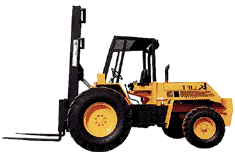
Rough terrain forklifts are also more versatile than their counterparts because of the variety of ground conditions on which they can operate. They are normally equipped with solid pneumatic tires. There tires are not filled with air so they cannot be "popped". They can travel over smooth services, unpaved, even broken up and tough sites like a recycling center. There are different options available on many models so that you can customize your lift to your needs.
Rough terrain lifts are your best choice for large loads and challenging terrain. Purchasing a rough terrain forklift is a big decision and one best made on solid information and experience. Talk to your staff and tax accountant to decide whether buying new, buying used, or leasing gives you the most value for your money.
Here are some things to consider when looking at leasing or purchasing a rough terrain forklift:
- Calculate the hours and level of use you are putting the lift through. A rough terrain truck lift must perform in conditions outside of a warehouse, so remember that you need a durable, road-worthy machine. Discuss with your team what type of use you expect for the lift in the coming years. When you estimate the number of hours at over 25 per week, you are better off buying the lift.
- If you are unsure about a model, leasing first is the best decision. If the plan is to buy a rough terrain forklift but you haven't been able to pull the trigger, short-term leases allow you an extended test drive to see what you are getting. This decision is best suited for companies that are about to take on significantly bigger workloads. A six-month lease should tell you all you need to know about any model lift, while the expense will be worth it in the end. The expense of this type of lease can be written off at tax time.
- Size up the difference between buying used or buying new. While the total weekly use also governs decisions about buying new or buying used, take into account the seller whose lift you're considering. Private owners and small businesses tend to work lifts more regularly than rental agencies. As a result, lifts from private owners could have as much as 30 percent more total use than those bought from forklift rental companies. While the price will be higher when buying a retired rental, you'll get a model with far less wear.
- The tax break could be the deal breaker. Equipment leases for small businesses may be written off entirely when you file your company's taxes, making the rental proposition very attractive regardless of whether you are getting equity for your payments. One exception could come with the tax loophole that allows businesses to write off 100 percent of heavy vehicle expenses. The issue will arise at the end of a forklift's life. If you sell to get market value for a used rough terrain forklift, you will have to pay the taxes you bypassed originally. If you buy and take the tax break, your only option is to trade in your lift and purchase a new one. Otherwise, your break is nullified.
| Rough Terrain Forklift Specifications | |
| Maximum available capacity | 35,000 lbs. or more |
| Power source | Gasoline, diesel fuel, liquid propane gas, or compressed natural gas engine |
| Costs | Lower purchase price Higher operating costs |
| Best used | Outdoors |
| Typical Applications | Lumber yards, Construction, Loading docks |
| Refueling time | 5 to 15 minutes |
Ready to talk to rough terrain forklift dealers near you? BuyerZone will connect you with the right suppliers - it's free and takes just minutes.
Ready to Compare Forklifts Price Quotes?